Dreamegg Sunrise Alarm Clock Review: Real User Experience After 3 Months
Introduction: Seeking a Better Way to Wake Up
I have never been a morning person. For most of my adult life, my relationship with the morning has been one of pure antagonism. I’ve relied on a series of increasingly loud, aggressive smartphone alarms that would jolt me out of deep sleep, leaving my heart racing and my brain feeling like it was wrapped in a thick fog for at least an hour. I tried the "gentle" chimes, the vibrating wristbands, and even those apps that make you solve a math problem before the noise stops. Nothing changed the fundamental problem: being ripped out of sleep by sound alone is a terrible way to start a day.
About four months ago, I started reading about the science of circadian rhythms and how light—specifically the gradual increase of light—can signal the brain to reduce melatonin and increase cortisol naturally. That’s what led me to the world of sunrise alarm clocks. While the big-name brands often retail for well over a hundred dollars, I found the Dreamegg Sunrise Alarm Clock. I was initially skeptical because of the lower price point, but after ninety days of consecutive use on my nightstand, I have some very specific thoughts on whether this budget-friendly option actually delivers on the promise of a peaceful morning.
Out of the Box: First Impressions and Setup
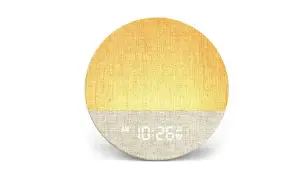
When I first unboxed the Dreamegg, I’ll be honest: I was a little worried about the build quality. It’s lightweight—perhaps a bit too lightweight—and the plastic has a smooth, matte finish that feels okay but doesn’t scream "premium electronics." However, once I plugged it in and the display lit up, my opinion started to shift. The design is a clean, circular "sun" shape that doesn't take up too much real estate on my bedside table, which is already crowded with a lamp and a stack of books.
The setup process was my first real hurdle. In my experience, many of these multi-functional clocks have a steep learning curve because they try to cram twenty features into six or seven buttons. The Dreamegg is no exception. I spent a good twenty minutes with the manual in one hand and the clock in the other, trying to figure out how to toggle between the 12 and 24-hour clock and how to set the "sunset" simulation versus the "sunrise" alarm. I found that I had to be very intentional with the button presses; they have a distinct "click" but if you hold them a half-second too long, you might accidentally enter a different setting mode. It wasn’t intuitive, but once I had my preferences locked in, I haven't had to touch the deep settings since.
The Sunrise Experience: Does It Actually Work?
The core reason I bought this device was the sunrise simulation. I set mine for a 30-minute fade-in. This means that if my alarm is set for 7:00 AM, the clock starts glowing at a very dim, deep red at 6:30 AM. Over the next half hour, it transitions through orange and yellow tones until it reaches a bright, cool white light at 7:00 AM.
In my first week, I noticed something remarkable. I wasn't always awake when the light reached its peak, but I was definitely in a lighter stage of sleep. When the "backup" sound (I chose a soft bird chirping noise) finally kicked in, I didn't feel that "startle response" in my chest. By the second month, I found myself consistently opening my eyes about five to eight minutes before the sound alarm was scheduled to go off. My bedroom felt like it was filled with morning sun, even though my heavy blackout curtains were still tightly shut.
What I found particularly effective was the color temperature. Some cheaper sunrise clocks just get brighter without changing color, but the Dreamegg actually shifts from that warm, ember red to a daylight white. I noticed that this transition feels much more "natural" to my closed eyelids than a simple dimming bulb. It mimics the spectrum of a real dawn, which I think is the secret sauce to why I feel less "sleep drunk" (physically known as sleep inertia) when I get out of bed now.
Sound Quality and Variety
I’ve tested all the built-in sounds, and there is a definite hierarchy of quality. The "Nature" sounds—like the campfire, the rain, and the birds—are actually quite good. They don't have that obvious, short "loop" sound that drives me crazy on cheaper white noise machines. I found the ocean wave setting particularly soothing for the sunset mode.
Discover deals on Electronics — updated daily.
View Offers →However, I was disappointed by the FM radio and the more "musical" alarm tones. The speaker on the Dreamegg is clearly optimized for mid-range frequencies, which works well for white noise but makes music sound thin and "tinny." I tried using the FM radio as my wake-up sound for a few days, but the reception was mediocre even with the wire antenna fully extended, and the audio quality just wasn't pleasant enough to want to listen to while waking up. For me, the nature sounds are the only way to go.
The Sunset Simulation: An Unexpected Benefit
While I bought this for the mornings, the "Sleep Aid" or sunset function became a staple of my nightly routine. You can set a timer (I usually do 20 minutes) where the light gradually dims and the sound lowers in volume until both turn off completely. As someone who struggles with "revenge bedtime procrastination"—scrolling on my phone because I don't want the day to end—having the room slowly grow darker is a powerful psychological cue that it’s time to put the phone away. I noticed that I fall asleep significantly faster when I use the sunset mode compared to when I just flip a standard lamp switch.
Daily Usability and Small Frustrations
After three months, I’ve identified a few "quirks" that a casual reviewer might miss. First, the snooze button is located on the top, but it’s part of a row of several other buttons. In the dark, when you’re half-asleep, it can be hard to find by touch alone. I’ve accidentally changed the light color or turned the alarm off entirely when I was just trying to snooze for nine more minutes.
Another thing that bothered me initially was the brightness of the time display. Even on the "low" setting, the blue-white LEDs of the digital clock felt a bit bright in a pitch-black room. Fortunately, I discovered you can turn the time display off completely, but then if you wake up in the middle of the night, you have to hit a button to see what time it is. I eventually settled on the lowest brightness, but I wish the numbers were amber or red instead of white, as red light is less disruptive to night vision.
Comparison: Dreamegg vs. High-End Alternatives
I had the chance to stay at a friend's house who uses one of the original high-end Philips Somneo models. Comparing the two gave me a lot of perspective. The high-end models definitely feel more substantial and have "smarter" features like app integration and sensors that track room temperature or humidity. However, in terms of the actual light quality—the smoothness of the fade and the color accuracy—the Dreamegg holds its own surprisingly well. For one-third of the price, you're getting about 85% of the experience.
| Feature | Dreamegg Sunrise Clock | Standard Digital Alarm | Premium Brands (e.g. Philips) |
|---|---|---|---|
| Light Source | Full Spectrum LED (Red to White) | None | Premium LED + Ambient Sensors |
| Sound Options | 11 Nature Sounds + FM Radio | Buzzer Only | 20+ Sounds + App Streaming |
| Sunset Mode | Yes (with sound fade) | No | Yes (with guided breathing) |
| Build Quality | Lightweight Plastic | Varies | Premium Glass/Soft-touch Plastic |
| Ease of Use | Moderate (Button heavy) | High | High (often App-controlled) |
Pros and Cons: The Honest Breakdown
After ninety days of daily use, here is my list of what makes this clock a winner and where it falls short of perfection.
- Pro: Effective Light Gradient. The transition from deep red to bright white is smooth. I don't see "steps" in the brightness levels, which is a common complaint with cheaper LED clocks.
- Pro: Dual Alarm Settings. I love that I can set one alarm for my Monday-Friday grind and a completely different one for the weekends without having to reprogram it every Sunday night.
- Pro: Versatile Nightlight. Outside of the alarm functions, it works as a great bedside lamp. You can choose static colors (blue, green, pink, etc.), which is nice for mood lighting or reading.
- Pro: Battery Backup. We had a power flicker last month, and the internal backup battery saved my settings. I didn't have to spend twenty minutes recalibrating the clock, which was a huge relief.
- Con: Small, Non-Textured Buttons. The buttons stay flush with the casing, making it very difficult to operate by feel in the dark. Designing the snooze button with a different texture would have been a massive improvement.
- Con: FM Radio Quality. As mentioned, the radio is almost an afterthought. The signal is weak, and the audio is thin. If you’re a die-hard NPR-in-the-morning person, this might not satisfy you.
- Con: Learning Curve. The instruction manual is essential. Don't throw it away, because you won't remember the button combinations if you need to change your "Sunrise Duration" six months from now.
Buying Guide: Is a Sunrise Alarm Right for You?
Before you commit to the Dreamegg or any light-based alarm, you should consider your sleep environment and habits. In my experience, these clocks work best for people who fall into the following categories:
The Blackout Curtains User: If you live in an urban area and use heavy curtains to block streetlights, you’re also blocking the natural sun. A sunrise clock is almost mandatory in this setup to give your brain the light cues it needs to wake up properly.
Shop the latest Electronics picks on Amazon.
View Offers →The Seasonal Affective Disorder (SAD) Sufferer: While this isn't a medical-grade light therapy lamp (those are much brighter, usually 10,000 lux), I noticed a significant improvement in my mood during the dark, rainy weeks of late winter. Having a "sun" in my room at 6:30 AM made the gray days feel less daunting.
The Heavy Sleeper: If you usually sleep through noise but are sensitive to light, this will change your life. However, if you can sleep through a wildfire, make sure you choose one of the louder nature sounds (like the "Beep" or the "High Volume Birds") as your backup. The Dreamegg gets surprisingly loud, which is a plus for deep sleepers.
What to Look For: When shopping, always check for "Duration Adjustment." One thing I appreciated about the Dreamegg is that I could choose a 10, 20, 30, or even 60-minute sunrise. Some cheaper models are hard-coded to 30 minutes, which doesn't work for everyone. Some people need a long, slow 60-minute "dawn" to fully emerge from sleep.
Final Verdict: Three Months Later
So, after three months, am I still using the Dreamegg Sunrise Alarm Clock? Absolutely. Despite my gripes with the button layout and the mediocre radio quality, the core function—the sunrise simulation—has fundamentally changed how I feel when I stand up in the morning. I no longer feel like I'm being dragged out of a dark hole by a screaming phone.
What I found most surprising was how much I grew to rely on the sunset mode for my evening wind-down. It has become a Pavlovian trigger for me; when the light starts to turn orange and the rain sounds start, my brain knows that the "work day" is officially over and sleep is coming. For the price, the Dreamegg offers a high-quality light experience that rivals much more expensive units. It’s not a perfect piece of industrial design, and the interface could be friendlier, but as a tool for improving sleep hygiene and morning alertness, it is one of the best investments I’ve made in my bedroom setup this year.
In my experience, if you are looking to dip your toes into the world of light-based waking without spending a fortune, this is the specific model I would recommend. It does the "big things" right—the light spectrum, the fade smoothness, and the nature sounds—while letting the "little things" like radio quality slide. If you can handle a slightly frustrating setup period, the reward is a much more peaceful start to your day.